


The Trust Gap in Tech Accessories — Why Reliability Matters More
Today
Over the past decade, the market for tech accessories has expanded rapidly. Charging cables, powerbanks, and adapters have become everyday essentials that quietly power the devices we rely on most. Despite their small size, these products play a critical role in keeping our digital routines running smoothly.
Yet as the market continues to grow, many consumers are starting to notice a different
challenge: trust. Choosing an accessory today is no longer just about finding the right
specification or the lowest price. Increasingly, people are asking a more important question — whether the product will remain reliable long after the purchase is made.
This shift is also changing how accessories are designed. More users are beginning to value products built around real-life usage rather than just technical specifications. Instead of focusing purely on features, a more thoughtful approach is emerging — one that considers how, where, and how often accessories are used in everyday life.
For users within the Apple ecosystem, these expectations are even higher. Accessories are no longer seen as simple add-ons, but as extensions of devices like the iPhone, iPad, and MacBook.
Compatibility plays a critical role, which is why certifications such as MFi (Made for iPhone/iPad) have become increasingly important in ensuring stable performance and longterm reliability. Beyond charging, newer integrations like Made for Apple Find My further reinforce how accessories are becoming part of a more connected and seamless ecosystem.
At the same time, everyday usability is becoming just as important as performance. Products like powerbanks are now expected to be travel-ready — compact, durable, and safe to carry across different environments. Compliance with safety standards, such as 3C certification, adds another layer of reliability that users may not immediately see, but will depend on over time.
Ultimately, accessories are no longer treated as disposable items. More users now see them as part of the long-term experience of using their devices — making reliability a defining factor in purchase decisions.
Electronics Are Among the Most Counterfeited Products
One reason behind this growing trust gap is the sheer scale of counterfeit and low-quality products in the electronics market. According to the Organisation for Economic Co operation and Development, electronics are among the most counterfeited categories in global trade.
Accessories are particularly vulnerable because they are relatively easy to manufacture compared to more complex devices such as smartphones or laptops. Two cables may look almost identical on the outside, but internally they can be built with very different materials and component quality.
For consumers, these differences rarely appear immediately. A cable may function perfectly during the first few weeks, only to develop problems later. Fraying connectors, unstable charging performance, or cables that stop working altogether are experiences many users are familiar with.
Because these issues often emerge over time, the real test of an accessory is not how it performs on day one — but how it performs months later.
Consumers Are Becoming More Careful
As a result, consumers today are more cautious when choosing technological products.
Research from the Edelman Trust Barometer shows that trust in brand messaging has declined over the years, with people relying less on advertising and more on actual product experience.
This does not mean consumers distrust brands entirely. Rather, it means they expect stronger proof of reliability. Clear product information, consistent performance, and transparent support policies are becoming more important factors in building long-term trust.
In the world of accessories, this shift is particularly significant because these products interact directly with devices people depend on every day.
The Complication of Online Reviews
Online reviews once helped simplify the buying process. They allowed potential buyers to see the experiences of others before making a decision. However, the reliability of reviews has also become more complicated.
A study by BrightLocal found that many consumers are increasingly aware of fake or manipulated reviews online. While reviews are still useful, people are now more cautious about taking them at face value.
This means consumers are no longer evaluating only the product itself, but also the credibility of the information surrounding it. The result is a more careful and sometimes more skeptical purchasing process.
Why Accessories Are Especially Affected
Among all technology categories, accessories face a unique challenge. The market has relatively low barriers to entry, allowing many manufacturers to produce similar products with widely varying levels of quality.
Most marketing conversations focus on specifications such as power output or charging speed. While these features are important, they do not always reflect the everyday experience of using the product.
What many users ultimately care about is much simpler: how long the product lasts and how reliably it works in daily routines. A cable that charges quickly but fails after a few months often creates more frustration than one that simply works consistently over time.
For this reason, durability is becoming one of the most important qualities consumers look for in accessories.
Why This Matters Even More for Apple Users
For users within the Apple ecosystem, accessories often play an even more significant role. Many Apple users invest heavily in devices such as the iPhone, MacBook, and iPad, which are designed to work seamlessly together.
Because of this interconnected ecosystem, accessories become more than simple add-ons — they are part of the overall experience. Reliability, compatibility, and design harmony all contribute to how smoothly devices function in daily life.
This is why certified compatibility matters. Accessories that meet standards like MFi (Made for iPhone/iPad) are designed to ensure stable charging, safe performance, and long-term usability. As the ecosystem evolves, integrations like Apple Find My further expand how accessories connect and interact, making reliability even more critical.
The Conversation the Industry Often Misses: Durability
For many years, accessory marketing has focused heavily on performance numbers. Charging speed, power delivery, and maximum wattage often dominate product descriptions. However, when users talk about their real frustrations with cables, speed is rarely the main issue. Most modern cables already support fast charging. What people remember instead are the cables that stopped working too soon.
Common issues such as frayed connectors, loose cable heads, or internal wire damage tend to appear after months of everyday use. These small failures often lead to repeated replacements, creating unnecessary costs and inconveniences. In many ways, the industry is slowly realizing that real competition is no longer about speed alone. It is about long-term reliability.
Designing Accessories Around Everyday Life
Cables are used in environments that are far from static. They are bent repeatedly, packed into bags, wrapped around devices, and plugged in multiple times a day. Over time, these small stresses can accumulate and weaken the product.
This applies not only to cables but also to power solutions such as powerbanks. As users become more mobile, these products are expected to support daily movement — from commuting to travel — without compromising safety or performance.
Because of this, designing accessories is not just about electrical capability. It is about durability, safety, and consistency in real-world usage. Material quality, reinforced connectors, and compliance with safety standards all contribute to whether a product can withstand everyday demands.
Ultimately, the best accessories are the ones that integrate naturally into daily life — working reliably in the background without disruption.
The Tunova Approach
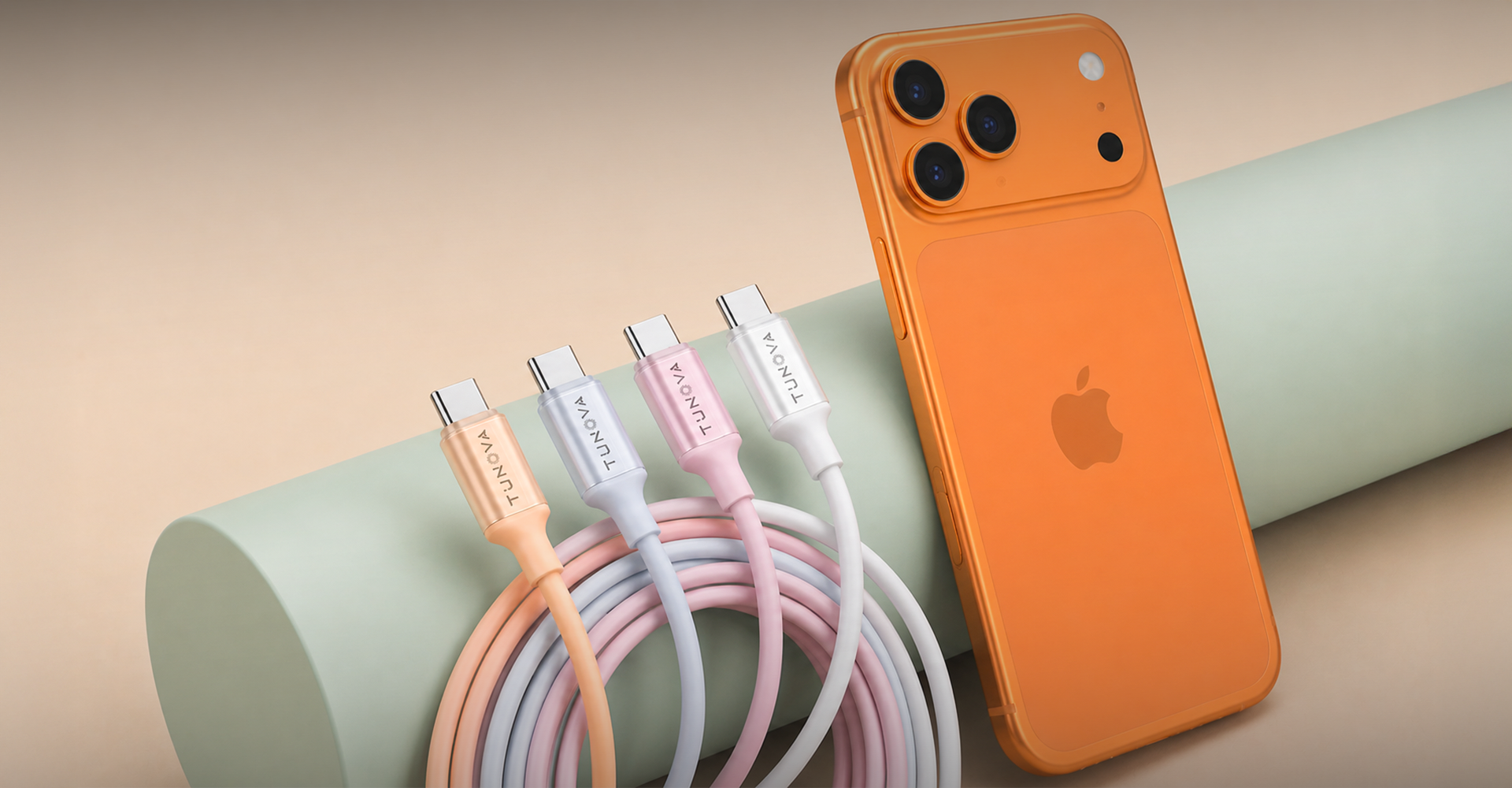
At Tunova, accessories are designed with this everyday reality in mind. Instead of focusing purely on technical specifications, the brand approaches product development through real user scenarios.
This product architecture is built around how people actually use their accessories — whether in stable environments, on the move, or in more demanding conditions.
The result is a clear and intentional lineup: Silky, Fluid, and Titanium.
Silky cables are designed for calm, stable environments such as bedside charging or desk setups. Their soft texture and flexibility make them comfortable to use while maintaining a clean and minimal aesthetic.
Fluid cables are built for mobility. They are designed to move with users throughout the day, balancing flexibility and durability for dynamic, on-the-go usage.
Titanium cables are created for more intensive use. With reinforced structures and stronger connectors, they are designed to withstand higher stress and reduce the need for frequent replacement.
By organizing products around real usage rather than just specifications, Tunova aims to create accessories that feel intuitive, reliable, and aligned with modern lifestyles.
Trust Continues After Purchase
In today’s crowded accessories market, trust is built through more than marketing claims.
Durability, certification, transparency, and reliable support all contribute to a better long-term experience.
That is why Tunova products are backed by a 2-year warranty, reflecting the brand’s
commitment to quality and accountability.
For users who depend on their devices every day — especially within ecosystems like Apple — the experience after purchase is just as important as the purchase itself.
Accessories may be small products, but when built around real usage, certified reliability, and everyday usability, they can quietly improve how technology fits into our lives.
Explore more at:
https://tunova.co
What Is Qi2 Wireless Charging and Why Does It Matter for Your Phone?
Why Apple Users Prefer Accessories That Match the Apple Ecosystem